



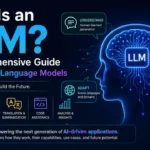

A Large Language Model (LLM) is a specialized subset of artificial intelligence and deep learning engineered to comprehend, summarize, translate, predict, and generate human language. At their core, LLMs are massive statistical engines trained on hundreds of billions (or trillions) of words from books, code repositories, websites, and research papers.
Unlike traditional software that relies on rigid, rule-based algorithms (if/else logic), LLMs utilize deep neural networks to identify complex statistical patterns, semantic relationships, and contextual nuances across human language.
The Core Engine: The Transformer Architecture
Modern LLMs owe their capabilities to the Transformer architecture, a deep learning framework introduced in the seminal 2017 research paper “Attention Is All You Need.”
Prior neural network models—such as Recurrent Neural Networks (RNNs) and Long Short-Term Memory (LSTM) networks—processed text sequentially, word by word. This caused two major bottlenecks:
-
Vanishing Gradients & Memory Constraints: Sequential models forgot early context in long documents.
-
Lack of Parallelization: Text could not be processed concurrently, making training on massive datasets extremely slow.
Key Technical Components of Transformers:
-
Self-Attention Mechanism: Allows the model to evaluate the relative importance (weight) of every token in a sentence relative to every other token, regardless of their distance. For example, in “The bank of the river was muddy,” the attention mechanism links “bank” to “river” rather than financial institutions.
-
Multi-Head Attention: Enables the network to jointly attend to information from different representation subspaces at different positions simultaneously.
-
Positional Encodings: Injects spatial order into the input vectors so the model understands token placement without sequential processing.
How LLMs Work: From Unstructured Text to Autoregressive Token Generation
[ User Input Text ] ──► [ Tokenizer ] ──► [ Vector Embeddings + Positional Encoding ]
                                                              │
                                                              ▼
[ Autoregressive Output ] ◄── [ Softmax Layer ] ◄── [ Multi-Head Attention Layers ]
The Three Stages of Training an LLM
[ Unsupervised Pre-Training ] ──► [ Supervised Fine-Tuning (SFT) ] ──► [ Alignment / RLHF ]
(Raw Web Crawls / Terabytes) (Curated Instruction Datasets) (Human Preferences)-
Unsupervised Pre-Training: The base model ingests trillions of raw tokens. It learns grammar, factual knowledge, and reasoning capabilities by solving a simple self-supervised task: Next-Token Prediction. This stage requires thousands of high-performance GPUs (like NVIDIA H100s/B200s) running for months.
-
Supervised Fine-Tuning (SFT): The raw base model is refined using curated, high-quality question-and-answer pairs. This teaches the model how to act as a helpful assistant rather than merely completing random web text.
-
Alignment (RLHF / DPO): Models undergo Reinforcement Learning from Human Feedback (RLHF) or Direct Preference Optimization (DPO) to align outputs with human values, ensuring responses remain helpful, accurate, and safe from toxic generation.
Key LLM Concepts and Terminology Matrix
| Term / Semantic Concept | Definition & Technical Impact |
| Context Window | The maximum number of tokens an LLM can process in a single prompt/response cycle (e.g., 128K to 2M+ tokens). |
| Parameters | The internal weights and biases learned during training (e.g., 7B, 70B, 405B parameters). Higher parameter counts generally correlate with stronger reasoning capabilities. |
| Quantization (GGUF/AWQ) | A compression technique that lowers weight precision (e.g., converting 16-bit floats to 4-bit integers) to run models on consumer VRAM/RAM with minimal loss in fidelity. |
| Hallucination | When an LLM generates syntactically confident but factually incorrect or ungrounded statements. |
| Retrieval-Augmented Generation (RAG) | Architectures that fetch external documents from a Vector Database and insert them into the LLM context window to ground responses in real-time facts. |
| Temperature & Top-P | Hyperparameters controlling output randomness. Low temperature (0.0–0.2) yields deterministic, precise responses; high temperature (0.7–1.0) increases creativity. |
Open-Weight vs. Proprietary Closed Models
The modern LLM landscape is split into two major development philosophies:
-
Proprietary / Closed-Source Models: Developed by organizations like OpenAI (GPT-4o), Anthropic (Claude), and Google (Gemini). They are accessed exclusively via paid API endpoints or web interfaces. They lead in raw benchmark performance but offer zero visibility into model weights or data privacy.
-
Open-Weight Models: Pioneered by models like Meta’s Llama, Alibaba’s Qwen, Mistral AI, and DeepSeek. Their weights can be downloaded, fine-tuned, and self-hosted locally using frameworks like Ollama or LM Studio, enabling 100% data sovereignty.